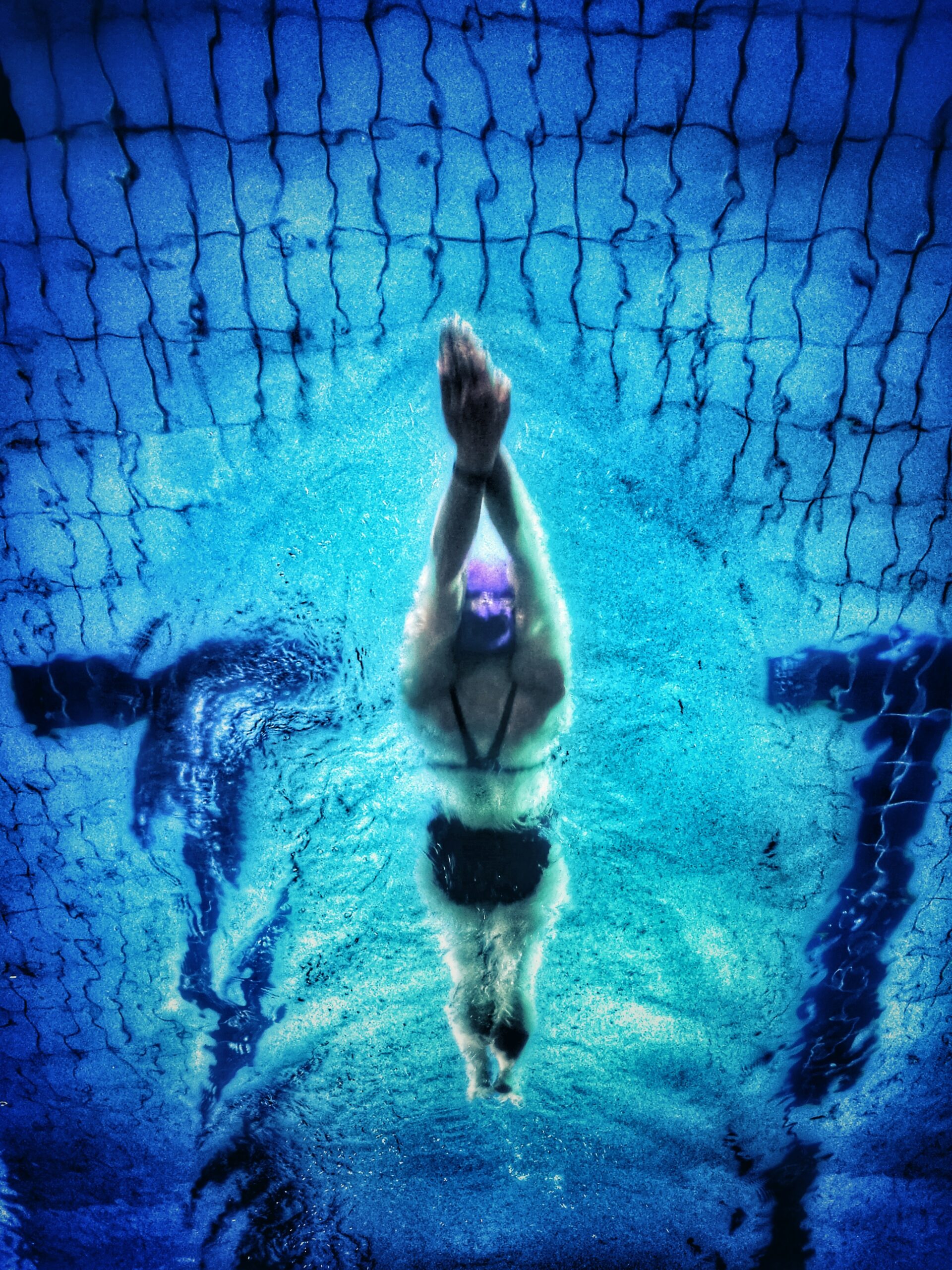
Let us now suppose that Jessica, a woman struggling with the scenario above, desires to overcome her fear so she may enjoy unexplored avenues of her life, so she schedules a meeting with a therapist.
What should the therapist do to help Jessica reach her goal of swimming independently in the water?
Establishing trust and developing the therapeutic alliance seems like an obvious first step, but is that all Jessica needs?
Next, Jessica works with her therapist to address her fear and process her trauma. Over time, her cognitive distortions about water are reduced along with the emotional response she produces when reliving that day when she almost drowned at seven years old. Eventually, Jessica becomes confident that she can now get into the water.
What will happen if she jumps into the pool?
She will drown.
Even if the therapist went further than overcoming the fear and explained that the mechanics of swimming involves paddling arms, kicking feet, and holding breath on occasion, she would still fail. Knowledge does not equate to skill; simply recognizing the difference between strokes doesn't translate to success in the water.
If Jessica's therapist is committed to helping her succeed in her goal outside of treatment, it's time to grab that bathing suit and jump in the pool with her; not just once, but time, after time, after time. For complex processes in the brain, extensive practice is required to move a conscious thought to an unconscious automated process. Think about the last time you were in the water and if you were consciously thinking about what your arms and legs were doing. The answer is, of course, no, you weren't; your brain has the procedural knowledge required to jump in and not even think about it.
In reality, Jessica's situation wouldn't require her therapist to get wet; there are professional swim coaches who would be more suitable to handle the practice piece of this scenario, but what if we adjust the lens? Let's think about this in terms of recovery. The problem isn't connected to successfully swimming in a pool but thriving in life when struggling with substance use disorder (SUD).
Like Jessica, these patients have a lot to address, process, and overcome in their past and present circumstances. Also, like Jessica, they need more than that. They need to be able to swim on their own or, in our case, automatically default to recovery skills.
Patients must be allowed to practice their recovery coping skills under various contexts and conditions while in treatment; this will give them the greatest chance of success once they leave the safety of the therapy space. Group therapy provides that opportunity and must be utilized more effectively and efficiently to help more patients find successful recovery.
Knowledge ≠ Skill
While both knowledge and skill have a part to play in recovery, a firm understanding of the differences between knowledge and skill-based learning is necessary to understand better the appropriate amount of time to allocate to skills practice in a group therapy session.
Knowledge, including facts and information, implies something theoretical; it can be transferred from one individual to another or acquired from books, observations, and studies.
On the other hand, skills are practical applications used in specific situations and cannot be directly transferred. Repetition and practice sharpen skills, and with enough of both, the brain will eventually create unconscious, automated processes that lead to unconscious processing and action (Ramnani, 2014; Swart, 2018).
Take reading, for example; when one first learns to read, meticulous attention is paid to individual letters and sounds, and blending and segmenting of phonemes to create words is done in stages of increasing complexity, as is matching those phonemes to their associated graphemes. The algorithm for reading is incredibly complex, and it is not until many years of repetition and practice that one becomes a fluent reader whose brain does all the sorting, matching, and placing for them, allowing the reader to focus on comprehension, making inferences, emotional responses to the text, and enjoyment. Of course, if an unfamiliar word pops up, all that automation comes to a screeching halt, and all focused attention diverts back to making sense of the unknown word. The same applies to driving a vehicle, riding a bike, typing on a keyboard, or appropriately conjugating verbs when having a conversation; these are complex processes people engage in daily without consciously thinking about them.
While many of us forget the struggles we had in the beginning, a simple test of this process is writing. Write your name with your dominant hand. Now right it with your non-dominant hand. 1) it looks worse because your brain has automated the muscle memory needed to write well, and 2) you’re much slower in general because the entire process hasn’t been automated.
Recovery capital skills such as restructuring negative thoughts, assertive communication, relaxation or calming techniques, breaking goals into manageable steps, and maintaining healthy boundaries are all examples of skills that, with enough practice, will become automated thought patterns and behaviors.
A common phrase in education is, "It is harder to unlearn than to learn." Unfortunately, it takes more effort to reroute an old behavior or thought pattern than it does to create a new one because rerouting produces resistance; this is why bad habits are so hard to break (Ramnani, 2014; Swart, 2018). On the bright side, people do break them, and the brain's learning systems provide insight into which types of learning strategies and practice situations will give the patients in group therapy the greatest chance at success
The Declarative and Procedural Pathways to Memory
One must examine the methods through which learning occurs in the brain to dive deeper into the distinctions through which knowledge and skill are acquired, retained, and recalled. The brain uses two preferred pathways to encode, process, and store information for later retrieval: declarative and procedural.
The declarative pathway to memory houses facts, events, and other retrievable knowledge. Declarative memory operates with the working memory, which maintains information for seconds at a time, and the hippocampus to keep information retrievable short-term, while the declarative pathway links with the neocortex for long-term memory. Declarative memory can also be episodic, where an incredibly salient event bypasses standard learning mechanisms and is burned into long-term memory as a method of survival; trauma is a form of episodic, declarative memory (Berge & van Hezewijk, 1999; Oakley et al., 2021).
In treatment, the declarative pathway has a role to play. Patients need knowledge and insight into their own behaviors. Combining that understanding with the facts about AUD and SUD will help create a more comprehensive, targeted plan for success. Furthermore, to help ensure every patient progresses during a session, the therapist should align the group's understanding of a particular topic. For example, if the session topic is assertive communication, patients must recognize the different attributes of aggressive, passive, and assertive statements before practicing reconstruction. The therapist can create this alignment more effectively by delivering the information through multiple media points.
Think of information like a highway; a variety of exposure methods such as visual, auditory, and hands-on experiences will create additional onramps to that highway; if a patient forgets what the therapist said but remembers the text, video, or image that supported it, they will still be able to access their information. Of course, as with the previous example of Jessica and her goal to swim, simply having this knowledge is not enough; to truly prepare patients, the procedural pathway takes center stage.
The procedural pathway to memory works with the neocortex, cerebellum, and basal ganglia to learn how to apply knowledge to practical situations and is the cause of habitual actions. Unconsciously, the procedural learning system is always watching, assimilating, and internalizing patterns that lead to unconscious automated processes (Berge & van Hezewijk, 1999; Oakley et al., 2021). Though it often takes longer to learn through the procedural learning system than the declarative, procedural memory seldom fails; "You never forget how to ride a bike" (Suchan, 2015). Furthermore, practicing under various conditions increases the likelihood that individuals will be able to transfer their skills to address more complex problems; the skills involved in restructuring negative thoughts can be applied to unraveling cognitive distortions, for example. Group therapy lends itself so well to proper patient practice because the group is filled with diverse individuals to practice with, and the therapist can create scenarios as close to real-life contexts as possible. Creating an "I" statement is far easier to do in isolation than it would be in the midst of a heated conversation. This is why the patient needs so much practice that the behavior/skill becomes automated. Imagine being in a fight with your significant other and asking them to wait a second while you formulate an “I” statement. It’s not going to happen. “I” statements need to be the default in order to be useful in spontaneous, emotionally charged conversations.
One of the greatest benefits of practice and the procedural memory system, as it applies to patients in therapy, is that it is employed when an individual is uninstructed, meaning they are not given direction (Oakley et al., 2021). If a patient is walking past a bar and feels the urge to go in and have "just one drink," the therapist will not be there to remind them which coping skill to use. If the patient receives enough practice in therapy, their procedural memory system will kick into gear, and they will be more likely to remove themselves from the situation, be on the phone with a sober support person, or play the tape through to the end automatically.
Will this happen every time? Not necessarily; practice does not make "perfect," but it certainly makes "better." More practice does just that; it increases the likelihood that patients will be able to successfully use their recovery skills once they leave therapy.
Strategic Planning and Deliberate Practice
When planning for patient practice opportunities, it is important to note that all practice is not equal. According to an article published by the American Psychological Association, "Deliberate practice is not the same as rote repetition. Rote repetition — simply repeating a task — will not by itself improve performance. Deliberate practice involves attention, rehearsal and repetition and leads to new knowledge or skills that can later be developed into more complex knowledge and skills. Although other factors such as intelligence and motivation affect performance, practice is necessary if not sufficient for acquiring expertise" (Brabeck & Jeffrey, 2015).
Strategic thought and planning are required to execute deliberate practice well, and activities should involve everyone every time. Role-plays, structured dialogues, and collaborative problem-solving exercises are useful to get patients practicing under various contexts and conditions. Assigning different roles and emotional states to group members will not only help everyone prepare for unpredictable interactions outside of therapy but will also help patients develop empathy for other points of view, develop their interpersonal skills, and build motivation.
What does strategic planning look like in group therapy?
Suppose the topic were "I" Statements. In that case:
The therapist would first ensure that everyone in the group can demonstrate understanding of the purpose of "I" statements and how they can be used to de-escalate confrontation, a common trigger, or aid in assertive communication, another CBT skill promoting recovery.
Next, they would compare good and bad examples to address any points of confusion before modeling and guiding patients to construct their own. These first steps utilize the declarative pathway and are guided by the therapist.
Once the group reasonably grasps the content, the magic of procedural, patient-centered learning can begin. Deliberate practice activities work best when delivered in a series of increasing complexity. For example, the first activity might see group members split into pairs to restructure premade accusatory statements into "I" statements; collaborative work is beneficial because partners help each other fill in knowledge and skill gaps.
A follow-up exercise might include dialogue cards containing confrontational situations that patients read to each other and modify on the spot to demonstrate skill competency.
Finally, patients would be invited to practice dialogue in an unscripted role play using situations and relationships from their life. The last activity is the most beneficial because it allows for practice in as close to real-life situations as possible, and it should be repeated as much as possible with different group members because, as with all unscripted role plays, no two conversations or reactions will be the same.
Knowledge, skill, and their respective unique learning methods in the brain both play a role in a patient's successful recovery. But, out of all the steps listed in the "I" statements strategic plan above, which one will truly benefit patients the most once they leave therapy?
So, the question is, once again, how much of the therapy session should be dedicated to that step?
The answer is simple; as much as possible.
Acquire Your Group Therapy Certification Today!
Call us to talk to one of our certified professional.
Brabeck, M., & Jeffrey, J. (2015, March 9). Practice for knowledge acquisition (not drill and kill). American Psychological Association. https://www.apa.org/education-career/k12/practice-acquisition
Oakley, B., Rogowsky, B., Sejnowski T., (2021). Uncommon Sense Teaching: Practical Insights in Brain Science to Help Students Learn. Penguin Publishing. 0593329740, 9780593329740
Ramnani N. (2014). Automatic and controlled processing in the corticocerebellar system. Progress in brain research, 210, 255–285. https://doi.org/10.1016/B978-0-444-63356-9.00010-8
Suchan, B. (2018). Neuroscience: Why don't we forget how to ride a bike? Scientific American. https://www.scientificamerican.com/article/why-dont-we-forget-how-to-ride-a-bike/
Swart, T. (2018). The 4 underlying principles of changing your brain. Forbes Magazine. https://www.forbes.com/sites/taraswart/2018/03/27/the-4-underlying-principles-to-changing-your-brain/?sh=f67f7115a71c
Berge, T & van Hezewijk, R. (1999). Procedural and Declarative Knowledge An Evolutionary Perspective. Theory and Psychology. 9. 605-624. 10.1177/0959354399095002.