No Pains, No Gains. If little labour, little are our gains: Man's fate is according to his pains.
— Hesperides (Robert Herrick, 1648)
One of the goals of group therapy is to have patients leave with more knowledge or skills than when they entered, meaning that therapy sessions qualify as a learning environment, so the terms learner and patient will be used interchangeably throughout this article. As such, it is important to understand stress's role in learning and retention. And while it would likely sound counterintuitive to promote intentionally inducing stress on patients in group therapy, in actuality, the right type of stress can serve as a positive force in recovery. The right type of stress can motivate, build self-efficacy, resilience, autonomy, and help patients learn and retain the knowledge and skills vital for recovery. In the biology of learning, positive stress that promotes memory retention and the creation of new neural links in the brain is referred to as eustress. In the simpler language of the world of education, we call it “desirable difficulty”, which, as we’ll discuss, exists within the learner’s zone of proximal development.
It is not surprising that stress has a negative connotation not only in popular culture but among many professionals as well. If we look to Hans Selye, the "father of stress research" and the first to apply the word to human physical and behavioral health, it is easy to understand why. According to Selye, stress is "the non-specific responses of the body to any demand for change" (1956). Change is difficult. Change carries perceptions of inadequacy, fear, and resentment, which is why humans often default to resistant behaviors when faced with it (Rehman et al., 2021). But, change can bring with it positive connotations when applied in the correct context, such as personal growth and development. Progress, improvement, and recovery are all words synonymous with positive change. After all, no one grows emotionally, physically, or makes gains in knowledge and skill by becoming complacent; no pain, no gain.
Different Types of Stress and Their Role in Learning
When we think of the word stress as it is commonly used, we are actually referring to distress, traumatic stress, or chronic stress, all of which have their part to play in learning, retention, and the ability to recall.
Distress is a negative feeling of emotional or physical tension that falls outside of one's coping abilities and produces feelings of anxiety. It is a more intensive and debilitating form of stress that can interrupt the brain's typical learning and recall responses at every stage of memory formation and learning; acquisition, consolidation, and retrieval (Neliseen et al., 2018). People who are under distress, chronic or acute, when presented with new information, are often too overwhelmed and caught up in their own emotions to employ the conscious attention that is required for acquisition to take place. Furthermore, high levels of norepinephrine, one hormone released by the hypothalamus when stress is detected, dampen the brain's ability for neuronal firing, effectively wiping the working memory clean. Similarly, intense feelings can override the brain's ability to retrieve information; it is why students who experience testing anxiety draw a blank no matter how much they studied. They walk in with all the knowledge they need to be successful, but then, suddenly, it is lost (Arnsten et al., 2012).
This all makes sense from a biological and evolutionary standpoint. The central nervous system (CNS) consists of two primary systems: the sympathetic and the parasympathetic. The sympathetic nervous system is the one that handles the fight or flight response in humans. The entire purpose of this system is to redirect all of the body’s energy and resources to immediate survival. When a lion jumps out of the tall grass in the savannah, memorizing multiplication tables, contemplating Maslow’s hierarchy of needs, or even digesting the food you just ate are not important. All energy goes into fight or flight so that you survive, after which point the parasympathetic nervous system will re-engage for long-term survival.
In individuals with chronic stress and trauma, part of the problem is that their sympathetic nervous system is constantly engaged, preventing or complicating the learning process. That is, of course, with the exception of the episodic memory created related to a threat to survival. If an event is strongly tied to an emotional or stressful event, then it can bypass the normal learning mechanisms and be burned directly into the brain's episodic memory (Drexler & Wolf, 2017); this is done as a survival mechanism. In our example with the lion, we obviously do not want to study multiple instances of flashes of yellow moving among the grass to determine if all flashes of yellow are dangerous or just specific ones. We’d get eaten by the lion before completing are very scientific and evidence-based inquiry! So our brains developed a process to immediately imprint what we’d refer to in the behavioral healths space as a traumatic event (Sapolsky, 2007).
Experiences like this are known as traumatic stress, and they help explain why trauma and PTSD are so hard to treat. In cases of traumatic stress, the same level of emotions that were experienced when the memory was created are relived during memory recall (Stevens et al., 2017). While beneficial for survival in our example with the lion, these traumatic memories can also be very problematic when overgeneralized. If our brains imprint the color yellow with danger, now we will have a triggering event every time we see the color yellow. Obviously, this is not conducive to daily living. This same mechanism happens with our soldiers. Rather than the fight or flight response being engaged when dressed in uniform fighting in the desert in Ramadi, their sympathetic nervous system is engaging any time they hear a loud noise. The brain has overgeneralized the danger trigger in memory. Thankfully, through therapeutic interventions such as exposure therapy and EMDR, therapists can help patients work through and lessen the emotional response tied to these traumatic memories (Center for Substance Abuse Treatment, 2014).
The last type of stress, eustress, is a positive force that allows humans to perform at their best and tackle daunting tasks. The nervous excitement one may feel during travel, purchasing a house, walking out onto the field to a screaming crowd, reaching the top of a rollercoaster, requesting a raise, asking someone on a date, or walking up to the altar are all examples of eustress. Eustress promotes motivation and feelings of excitement, improves performance, and builds resilience (American Psychological Association, 2014). The hormones released during periods of stress, epinephrine (adrenaline), norepinephrine, and cortisol, which are crippling to learning when received in too high doses, are the same that help one focus and improve both cognition and working memory when obtained in the correct quantities; it is the perfect setup for enhanced learning (Whiting et al., 2021); Dhabhar, 2018; Corbett et al., 2017).
Desirable Difficulty
In any learning situation, it can be difficult to create just the right amount of stress to have learners working at their optimal performance levels; if a task is too easy, the learner will lose interest; if it is too challenging, frustration will quickly push learners into distress.

The best way to promote eustress in a group therapy setting is by challenging patients with exercises of desirable difficulty.
Desirable difficulty refers to an achievable learning task that requires a considerable amount of challenge and is often delivered in stages of increasing complexity with corrective feedback and, when necessary, scaffolding support. Challenge is vital in a learning task because it promotes growth. It also requires conscious thought and attention, making patients less likely to lose interest or get distracted. Because the learner faces resistance during the task, they feel a sense of accomplishment upon completion. Corrective feedback helps guide the learner as they work through the problem by addressing misconceptions, redirecting negative thought patterns or actions, and offering advice or perspective on performance. If the learner doesn't respond to the feedback due to a lack of skill, then additional support, or scaffolding, should be offered.
Skills, recovery capital skills included, are developed on a continuum; you crawl before you walk; you walk before you run. In learning to read, you recognize and connect letters to sounds before learning to blend and segment, all which occurs before letter combinations have actual meaning for the learner. In the group therapy session, if a therapist were delivering CBT training on restructuring negative thoughts, they would likely start with recognizing cognitive distortions, the first step on the skills continuum. As patients become more competent in their first step, they can move on to restructuring techniques, self monitoring, gathering evidence, and generating alternatives. In order to truly master this skill, patients will need lots of practice, and that will involve intentionally introducing negative thought patterns or scenarios; without extensive practice within the safety of the therapy walls, how well will patients do when faced with a negative thought in a real-world situation? People need to practice skills in order to master them, and exercises of desirable difficulty can be applied to both independent and group practice.
Stephen Krashen, an educational researcher and expert on language acquisition, coined the term "comprehensible input" to describe a level of input slightly above a learner's current competence in a skill (1982). The idea is, if "i" represents where a patient is on the developmental skill continuum, the comprehensible input becomes "i +1," the appropriate amount of difficulty to keep a learner on track without them feeling it is too easy, so they lose interest, or too difficult and frustrating, so they give up and shut down. If a patient were to be engaged in an independent task in the group or for home practice, "i + 1" would be the appropriate level of challenge for that individual.
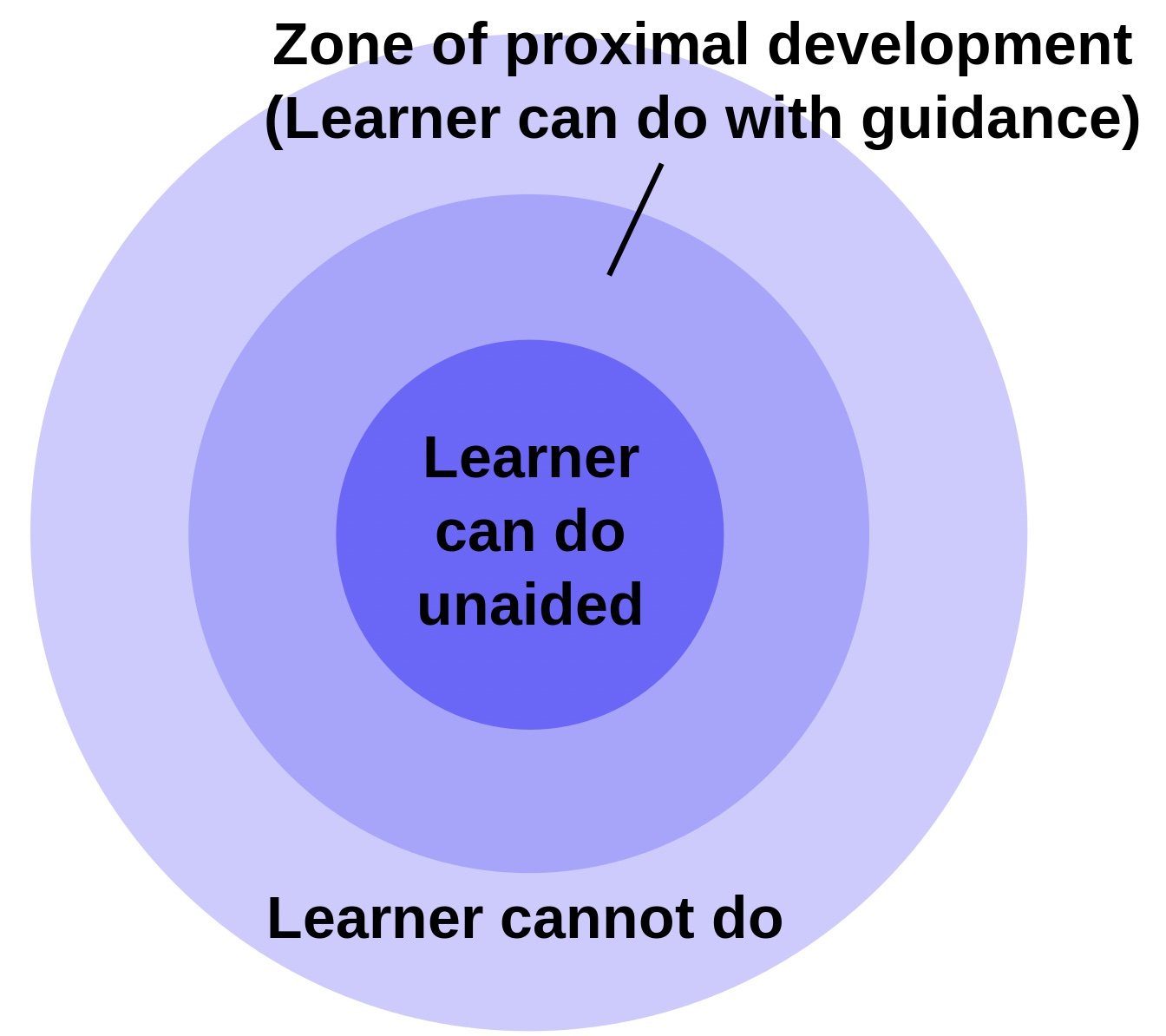
In reality, patients in a group will be at different levels in their recovery journey, so scaffolding will need to be employed to ensure all those involved will find their proper portion of desirable difficulty. For this, we look to psychologist Lev Vygotsky and the zone of proximal development (ZPD), which is defined as "the distance between the actual developmental level as determined by independent problem solving and the level of potential development as determined through problem-solving under guidance, or in collaboration with more capable peers" (1976). The creation of ZPDs within a learning space has numerous benefits for the group, including increased motivation, increased control and management of distress, and the development of self-efficacy as the responsibility gradually transfers from the facilitator or more capable group member to the patient (Walker, 2010).
Collaborative activities, project-based learning strategies, and engagement tasks are proven methods of creating desirable difficulty for a large number of people with varying levels of knowledge and skill. Because patients are engaged in the learning task at hand, they become less self-conscious, time flies by, and the result is a rewarding learning experience with improved retention and recall ability.
So, the next time you are planning your group session, look for a level of challenge that is difficult but attainable; not overwhelming, but certainly not too easy. The right type of stress for learning leads to improved acquisition, consolidation, and retrieval. Your patients will thank you, and their outcomes will improve.
Acquire Your Group Therapy Certification Today!
Call us to talk to one of our certified professional.

References
American Psychological Association. (2014). The Road to Resilience. 750 First St. NE, Washington, DC 20002-4242
Arnsten, A., Mazure, C. M., & Sinha, R. (2012). This is your brain in meltdown. Scientific American, 306(4), 48–53. https://doi.org/10.1038/scientificamerican0412-48
Center for Substance Abuse Treatment (US). Trauma-Informed Care in Behavioral Health Services. Rockville (MD): Substance Abuse and Mental Health Services Administration (US); 2014. (Treatment Improvement Protocol (TIP) Series, No. 57.) Chapter 3, Understanding the Impact of Trauma. Available from: https://www.ncbi.nlm.nih.gov/books/NBK207191/
Corbett, B., Weinberg, L., & Duarte, A. (2017). The effect of mild acute stress during memory consolidation on emotional recognition memory. Neurobiology of learning and memory, 145, 34–44. https://doi.org/10.1016/j.nlm.2017.08.005
Dhabhar, F. S. (2018). The short-term stress response – Mother nature's mechanism for enhancing protection and performance under conditions of threat, challenge, and opportunity. Frontiers in Neuroendocrinology, 49, 175–192. doi: 10.1016/j.yfrne.2018.03.004
Drexler, S. M., & Wolf, O. T. (2017). Stress and memory consolidation. In N. Axmacher & B. Rasch (Eds.), Cognitive neuroscience of memory consolidation (pp. 285–300). Springer International Publishing. https://doi.org/10.1007
Krashen, S. (1982) Principles and Practice in Second Language Acquisition. Pergamon Press Inc. ISBN 0-08-028628-3
Nelissen, E., Prickaerts, J., Blokland, A. (2018). Acute stress negatively affects object recognition early memory consolidation and memory retrieval unrelated to state-dependency. Behavioural Brain Research. Vol 345. ISSN 0166-4328, https://doi.org/10.1016/j.bbr.2018.02.027.
Rehman N, Mahmood A, Ibtasam M, Murtaza SA, Iqbal N and Molnár (2021) The Psychology of Resistance to Change: The Antidotal Effect of Organizational Justice, Support and Leader-Member Exchange. Front. Psychol. 12:678952. doi: 10.3389/fpsyg.2021.678952
Selye, H. (1956). The stress of life. McGraw-Hill.
Stevens, J. S., Reddy, R., Kim, Y. J., van Rooij, S., Ely, T. D., Hamann, S., Ressler, K. J., & Jovanovic, T. (2017). Episodic memory after trauma exposure: Medial temporal lobe function is positively related to re-experiencing and inversely related to negative affect symptoms. NeuroImage. Clinical, 17, 650–658. https://doi.org/10.1016/j.nicl.2017.11.016
Vygotsky, L. S. (1978). Mind in society: The development of higher psychological processes. Cambridge, MA: Harvard University Press
Whiting, S. B., Wass, S. V., Green, S., & Thomas, M. (2021). Stress and Learning in Pupils: Neuroscience Evidence and its Relevance for Teachers. Mind, brain and education : the official journal of the International Mind, Brain, and Education Society, 15(2), 177–188. https://doi.org/10.1111/mbe.12282
Image: Yerkes and Dodson, Hebbian - Diamond DM, et al. (2007). " The Temporal Dynamics Model of Emotional Memory Processing: A Synthesis on the Neurobiological Basis of Stress-Induced Amnesia, Flashbulb and Traumatic Memories, and the Yerkes-Dodson Law". Neural Plasticity: 33. doi:10.1155/2007/60803. PMID 17641736., CC0, https://commons.wikimedia.org/w/index.php?curid=34030428